
Want to learn how to easily cut up a whole watermelon so you can enjoy it in just a few minutes? What about tips on picking out the juiciest, perfectly ripe one from the pile?
Sure, this might seem like a simple task for some people. But if you purchased a whole watermelon for the first time and are now tasked with figuring out how to get it open, then it might seem a bit tricky. (We all have to learn sometime!)

So if you are already a pro at cutting up this sweet fruit and are rolling your eyes at a whole article dedicated to walking someone through the steps one by one, then feel free to click away. But if you’d like some simple tips on getting a whole watermelon cut up into cubes in just a few minutes, then this article is for you!
I’m sure there are several different ways to cut up a watermelon. There are even some fancy devices that you can buy that will supposedly tackle the task for you. However, you don’t need to spend your hard-earned money on another gadget to store in your kitchen drawer.
With just a sharp knife, a cutting board, and four simple steps, this sweet and healthy side dish can be on the table in no time at all! (Make sure you also head to the bottom of the article to get some simple tips on picking out the freshest, most flavorful watermelon as well as to see a short video of the cutting-up process.)

How To Pick Out A Whole Watermelon & Easily Cut It Up
In addition to writing out the step-by-step directions, I’m also including several pictures to help illustrate exactly what I mean. I’m a visual learner, so hopefully that will help those of you who are the same.
Still a bit confused? No worries, because I also have a YouTube Short you can watch to see how I easily cut a whole watermelon while talking about each step. You can click on the link above or scroll down to see it at the bottom of the article.
(Need help with cutting up a pineapple? I’ve got an article for that, too!) Ok, now on to the steps!

Step 1: Wash & Make The First Cut
The first step I usually take is to wash the outside of the watermelon. While you don’t actually eat the rind (the green part), you do still cut into it.
If there is dirt or anything on the rind, it can get into the actual flesh from your knife cut. You don’t need to use soap or anything. Just give it a nice scrub under running water, dry it off, and you’re good to go!
After that, the next step is to cut the watermelon in half. It doesn’t really matter where you make the cut as long as it is in the middle. If you have a round watermelon, that choice is easy. If it is more of an oblong watermelon, then cut it on the short side.
Step 2: Cut Into Fourth – Easily Cut A Whole Watermelon
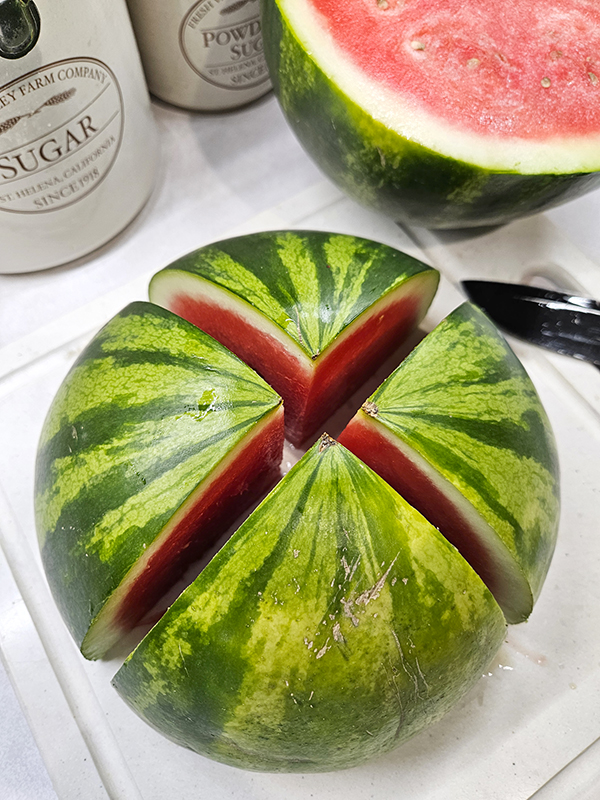
Now, you want to work with only one half of the watermelon at a time. Flip it over onto a cutting board so that the cut side is down (facing the board). This will give you a nice flat surface to cut on.
Take your knife and cut the watermelon half into fourths. To do this easily, I cut the watermelon piece in half, rotate it, and cut it in half again. (Refer to my images if that doesn’t make sense.)
Repeat this process with the other half of the watermelon. You should be left with eight smaller pieces at this point.

Step 3: Remove The Rind
Now that half of your watermelon is in eight pieces, work with one of these pieces at a time. Flip the piece over so that it is sitting on the rind.
You are going to cut along the rind on each of the three sides. To do this, take your knife and slide it along the rind so you have the white part on the bottom of the knife and the pink flesh on top. Only go about a third of the way into the piece.
Rotate the piece so you are working on a different side. Repeat the process again, stopping when you get about to the middle of the piece. Rotate and do the same for the last side.
At this point, the flesh should come off of the rind if your three cuts meet in the middle. If not, you may need to go a bit deeper on each side. Don’t worry if your cuts aren’t perfect. It takes a bit of practice to get the hang of things.
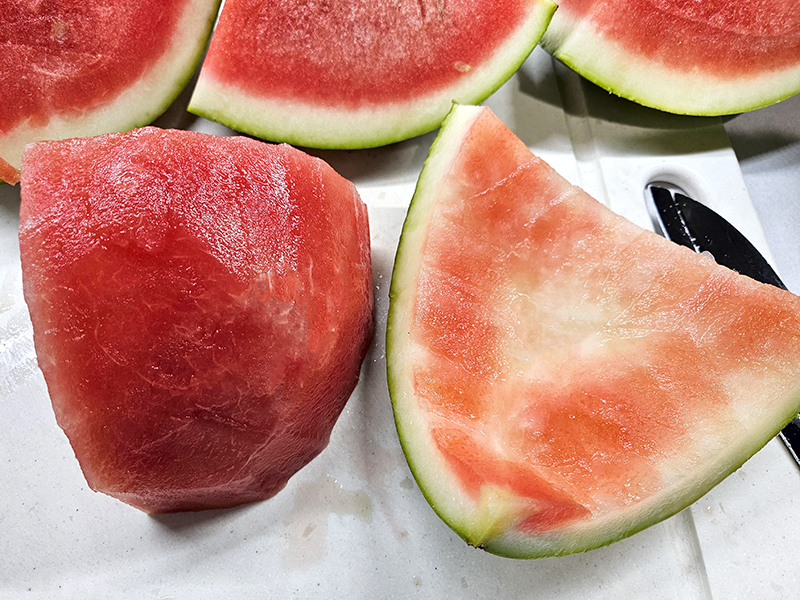
The goal is to get all of the pink flesh off of the rind in one big piece. If you see a bit of white on the flesh after cutting, just trim it off so that you are only left with pink. (The white part isn’t the most appetizing part of the watermelon!)
If you have some pink left on the rind, you can just cut that off and add it to the bowl with your other pieces. (I like to enjoy those pieces as my “worker’s fee”! Hey, you have to make sure the watermelon is tasty before you serve it!)
Repeat this process for the other seven pieces. The rind can be composted, tossed, or given to your chickens or livestock (our chickens love watermelon!).
Step 4: Make The Cubes – Easily Cut A Whole Watermelon
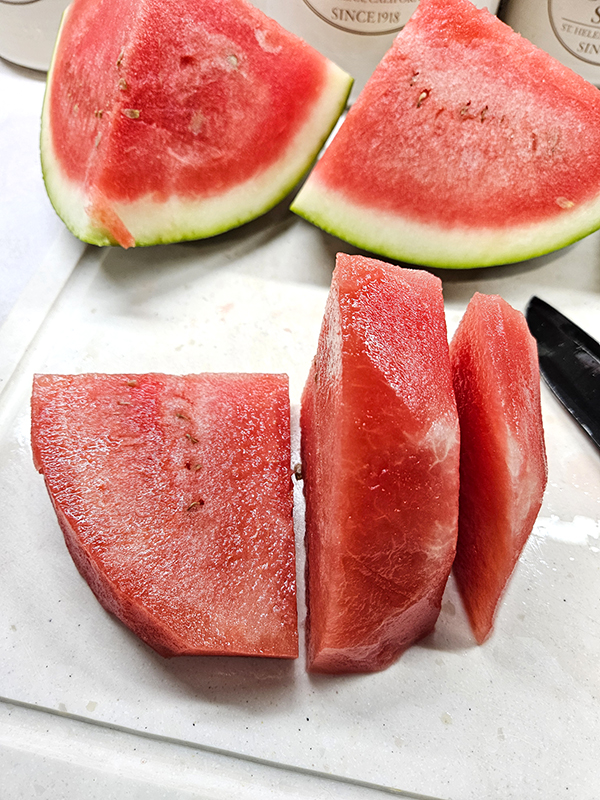
Now you should have eight pieces of only watermelon flesh. Again, working with one piece at a time, lay it on one of its flat sides.
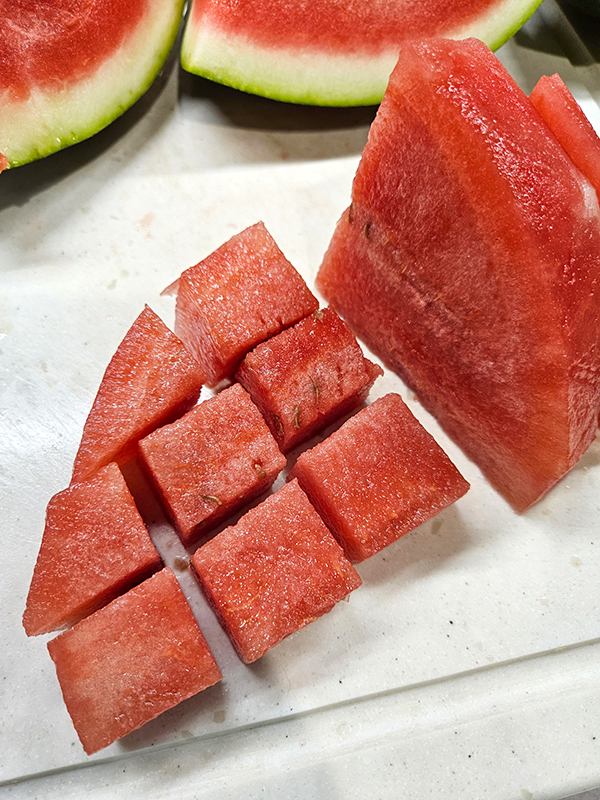
Depending on the size of the piece, cut it into thirds. This results in what I refer to as “steak” slices. Those can be served as-is if you want. However, we usually cut them into smaller pieces.
Each of those steaks can then be cut into strips of whatever width you prefer. I usually aim for around 1 to 2 inches wide. Again, you can serve the slices as is or go one step further and cut each strip into chunks that are about the same width on all sides.
Repeat with the other watermelon pieces, and that’s it! Once you get the hang of cutting off the rind, you can have a whole watermelon cut and sliced easily in just a few minutes.
Choosing The Best Watermelon
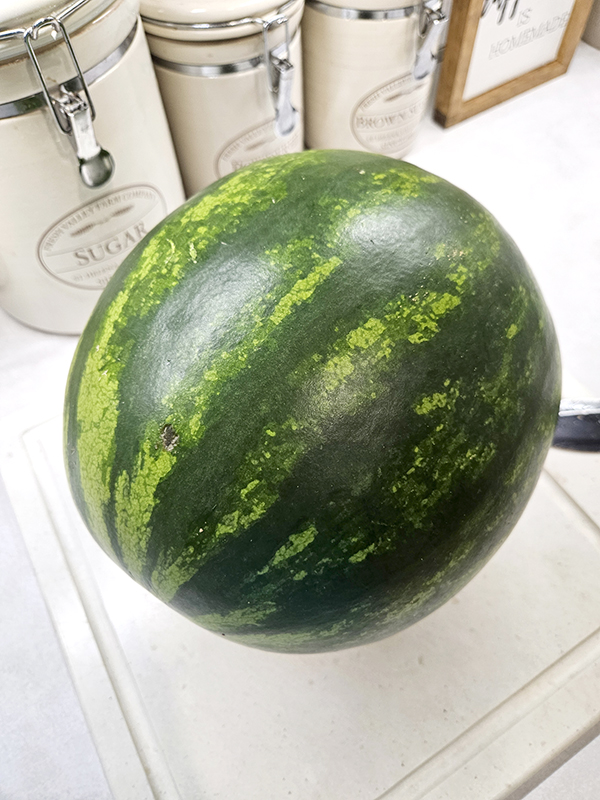
First off, choose a melon that has a symmetrical shape, has no soft spots, and is free of dents or cuts. A few light scratches here and there are fine.
The best way to choose a ripe, delicious watermelon is to look for what’s called the “field spot.” This is the part of the watermelon that was lying on the ground in the field. You want the spot to be a creamy yellow color. If there is no color change on the rind or if the spot is bright white, then the watermelon is likely unripe.
In addition to the field spot, look for webbing on the rind. This is a brown or beige zigzag pattern on the rind. While it might not make for a picture-perfect melon, the webbing shows that it has been well pollinated and should be really sweet.
Other Tips
Another way to check for ripeness is to feel the watermelon’s weight. A watermelon should feel heavier than it looks. This is a good indication that it is super juicy!
Also, look at the color of the rind as well. If the rind is shiny, then it is likely unripe. A ripe melon should be matte and have dark coloring.

Lastly, while it might feel a bit foolish, give the watermelon a light tap. It should emit a deep sound. If it sounds more hollow, it’s likely underripe.
Hopefully with these tips, you can feel confident in buying and cutting up a whole watermelon this summer!
Until next time, thanks for stopping by!
– Chelsea
*This post may contain affiliate links. These are products I have used personally and highly recommend. As an Amazon Associate, I may earn a small commission from qualifying purchases if you purchase items through my links. These links and the ads on this page help to support my family and our semi homestead, so Thank You!
Discover more from Semi Homestead Life
Subscribe to get the latest posts sent to your email.