
Do you need a bit of help with stopping a broody hen in your flock of chickens? While having a broody hen can sometimes be a great thing, a chicken keeper doesn’t always want or need a hen to hatch a clutch of eggs. In this case, the chicken needs to be broken of her broodiness.
“Broody behavior” is a natural instinct for a chicken to want to sit on a clutch of eggs to hatch them. A mixture of hormones, natural instinct, and light conditions will trigger this response in some hens.

The hen then stops laying her own eggs so she can sit on a clutch of eggs. She’ll stay there basically 24/7 for 21 days until the eggs hatch. Having a broody hen is a great way to hatch brand new chicks the natural way.
However, a broody chicken isn’t always the ideal situation. This is especially true if you don’t even have a rooster in your flock like us! A broody hen will sit on the eggs regardless of whether or not the eggs are even capable of hatching, which means she could be sitting for way longer than 21 days if no chicks appear.
Regardless of the reason, it’s a good idea to break the hen of the broody behavior as soon as possible. I’ll go into the reasons why as well as the easiest (and safest) way of stopping a broody hen below. Trust me, it’s a lot easier than you might imagine!
Tips On Stopping A Broody Hen
There are plenty of resources out there about how to handle a hen that you WANT to be broody. I don’t have any personal experience with that process, so I’m going to leave that up to the professionals.
But what I do have a lot of experience in is handling a hen that you DON’T want to be broody. Even with only having a few chickens, I still have a couple that go broody each year. (And some multiple times a year.)

If you notice the signs that a hen has gone broody, get to work as soon as possible. The sooner you can break her broodiness, the better. Sure, you can leave the hen alone to let nature do its thing, but it really isn’t in the best interest of the hen (or for you!).
Unfortunately, just removing her from the nest won’t do much good. Chances are, she will stay right where you set her and continue to complain. Soon after, she’ll make a beeline for the nesting spot again. You can repeat this process over and over again, but that is tough on both you and the hen! Thankfully, there is a better method for stopping a broody hen.
Separate The Hen – Stopping A Broody Hen
First, you want to remove the hen from her nesting area as soon as possible. It’s not enough just to remove the eggs from below the hen. She will still continue to sit in the same spot with no eggs, or she will just steal eggs from other nesting areas to sit on.
In order to stop her broodiness, you need to get her to a spot where she can’t see the space where she was sitting on the clutch of eggs. With our chickens, the nesting boxes are in the coop, and that’s where our girls go broody. So I set up a safe space for her inside the covered chicken run. This allows her to still be around the other chickens, but she can’t see the nesting boxes.
Don’t be surprised if the broody hen isn’t happy about her new digs. She will often let you know verbally as well as pacing frantically. Eventually, she will figure out that she is stuck there and will calm down.
Provide Airflow
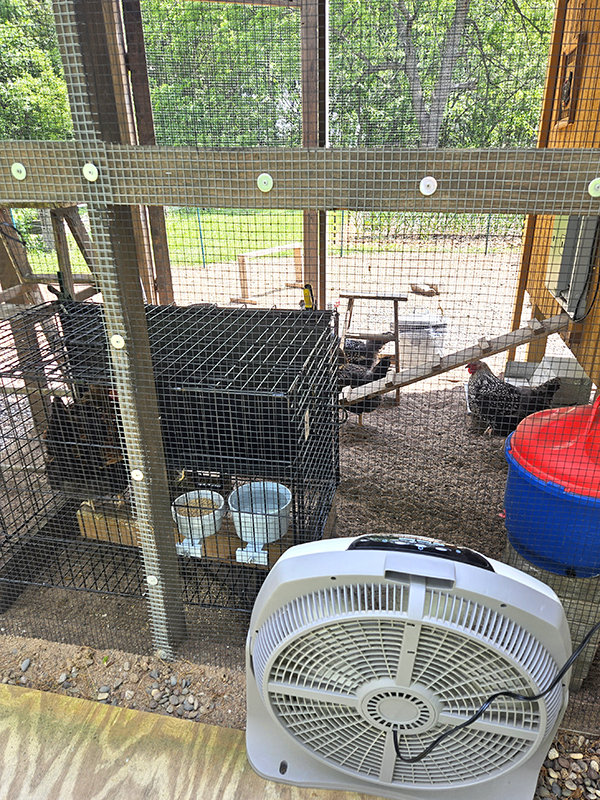
Not only do you want to keep the hen away from the nesting area, but you also want to get her up off the ground. This will allow airflow to work its way around the chicken and cool off her brood patch. (No warm and toasty bellies to warm up eggs!)
We like to use wire dog kennels for separating our broody or injured chickens. The cages are small, foldable, and easy to clean when the process is done. (This is similar to the smaller one we got at a yard sale a few years back – Product Link: Foldable Metal Wire Dog Crate with Tray.)
We remove the liner from the dog cage bottom so it’s only the wire part. Again, this is to help airflow. We usually then turn our cage on its side because the bottom wire is a bit wider than the other sides, and we don’t want the hen to have to walk on that side.
Setting Up The Cage
Inside the cage, we place a 4×4 board that the hen can sit on and “roost” during the day or night. We also include small containers for water and food. A broody hen might not eat much, but you still need to provide it for them. (We use both the 10 and 20 ounce size bowls, one for food and one for water. Product Link: Lixit Kennel Cage Water Bowl Hanging)
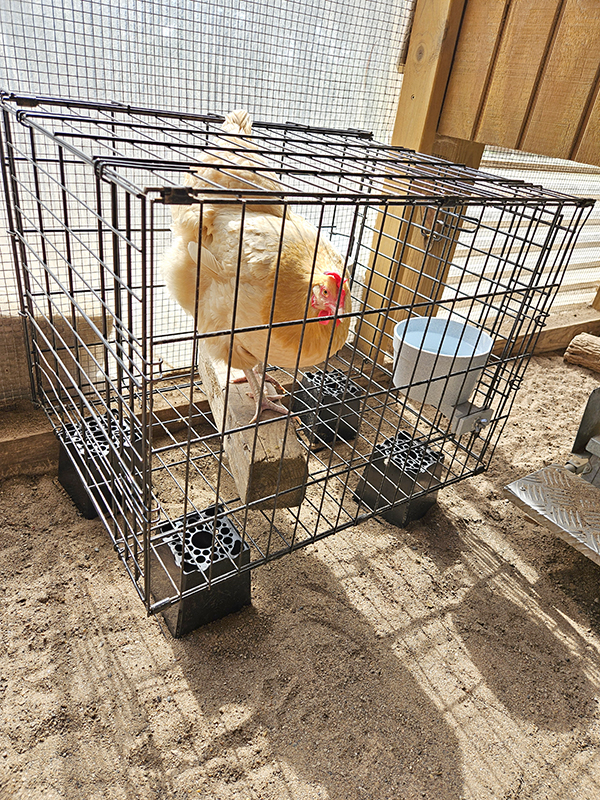
Then we set the cage up on some type of risers. I’ve used everything from additional 4×4 boards to my hard plastic seed starting containers. Anything sturdy and safe to get the cage up off the floor a few inches is fine.
Be sure to supply fresh food and water daily and clean the droppings under the cage. You also need to make sure that the hen is safe from predators. We keep the cage in our covered run so we can just close the door at night, keeping her protected by the hardware cloth.
Be Patient – Stopping A Broody Hen
The goal is to let the hen stay in her cage for at least 48 to 72 hours. I find that “most” hens are broken of their broody behavior after just two to three days, but some might take a little longer. The quicker you work on stopping the body behavior, the quicker the hen will get out of it and back to laying eggs for you!
After a day or two, watch the hen’s behavior to see when she is no longer broody. If she is walking around in the cage and eating, drinking, and pooping like normal, she might be broken.
If you walk up to the hen and she is still puffing up her feathers and being on the sassy side, then chances are she hasn’t been broken. Or, if you release her and find her back in the nesting area shortly thereafter, she needs to go back in the cage. (Broken hens won’t lay for at least a week after being broody.) Give her another day or two in the cage or wherever you placed her and try again.

What Helps Prevent Broody Hens
There’s really nothing you can do to help prevent a hen from going broody. It’s a natural instinct that some hens are simply born with. And just because a hen is broody doesn’t mean it will make a great mom. In fact, some hens are known to abandon their clutch of eggs after just a week or so. Other hens have been known to turn homicidal when the chicks actually hatch, so broody does not always equal a good mother!
But in cases like our homestead, we just don’t need a hen to be broody. There is no rooster here, so I can 100% guarantee that none of our eggs are fertilized and will ever hatch. Even if we had a rooster, it just might not be in the budget or good timing for a new batch of baby chicks to be brought into the world. So that’s why it’s important to break a broody hen as soon as possible.
One thing that “might” help reduce the chances of a broody tendency is to collect your eggs frequently. Sometimes, a pile of eggs might just be the last tempting thing a hen needs to see in order to go full-on broody!
Until next time, thanks for stopping by!
– Chelsea
*This post may contain affiliate links. These are products I have used personally and highly recommend. As an Amazon Associate, I may earn a small commission from qualifying purchases if you purchase items through my links. These links and the ads on this page help to support my family and our semi homestead, so Thank You!
Discover more from Semi Homestead Life
Subscribe to get the latest posts sent to your email.