
Raising chickens can be a lot of fun and so rewarding! But if you are just getting into it, you can get a bit overwhelmed with how many different items and features your chicken coop should include.
One article you read online might have a completely different suggestion from the next article. This can make things a bit confusing and stressful for someone just starting out with raising chickens.

But in all honestly, it doesn’t have to be that complicated. Chickens are fairly simple creatures. As long as a few basic needs are met, they will be good to go and happy as can be.
I am going to go over what I consider to be the most important features that your chicken coop should include not only for their safety but for their health as well.
Features Your Chicken Coop Should Include
A Safe Space
One of the most important features of your chicken coop is that it needs to be some sort of enclosed structure that is safe from hungry predators. That’s the main point of a coop. Chickens are vulnerable creatures when they are sleeping. There is no alpha chicken or rooster to alert them to danger, so they rely on you and the coop to keep them safe.
The coop should be completely enclosed with a solid roof as well. This will help protect the chickens not only from predators but also from the elements of nature as well.
Don’t use simple locks on your chicken coop doors or windows. Add carabiners whenever possible because predators like raccoons are agile and sneaky and can open most basic locks.
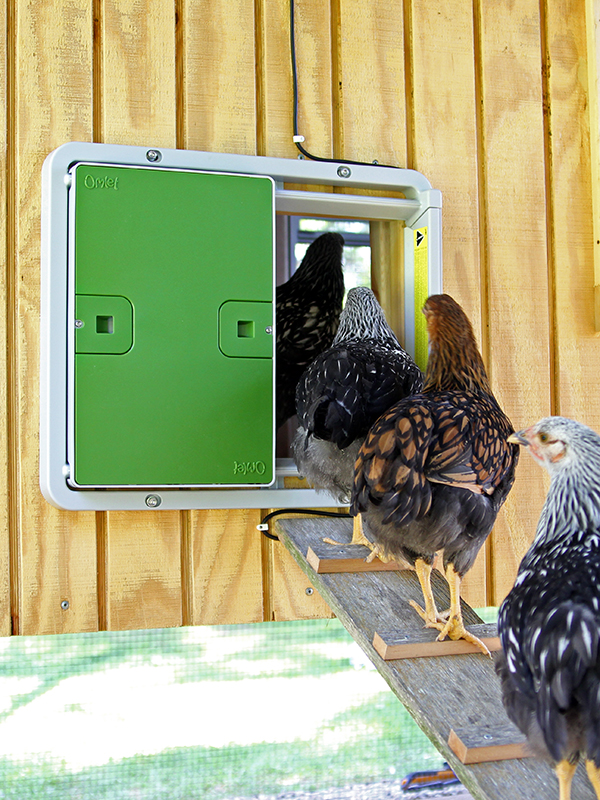
The coop also needs a door that closes at night. Whether you have to physically close the door yourself or you use an automatic door, the chickens have to be completely locked inside for their safety while sleeping. (Product Link: Omlet Automatic Door)
Roosting Bars
The roosting bars are the place where chickens sleep at night. You need elevated bars or boards that are about 2″ to 5″ in width for the chickens to stand on while they sleep. Each chicken should have about 10″ of space on the roosting bars, although most of the time they will crowd together on one.
Chickens in the wild will actually fly up into trees to sleep. So to mimic what comes naturally to them, your roosting bars should be elevated and higher than the nesting boxes. Otherwise, your chickens might just end up sleeping in the nesting boxes.
You also want to choose a flat board as opposed to a round one because it is better for their feet. I simply use a basic 2×4 with the 4″ side facing up. Both boards can be removed for cleaning or replacement as needed.
Nesting Boxes
There are so many different things you can use to create nesting boxes, but this is a feature chicken coops must include if you want to gather fresh eggs (isn’t that part of why you are raising chickens in the first place!). The main goal is that it is a quiet, dark place where the chickens can feel safe to go and lay their eggs.
You need about one nesting box per four chickens. I have three nesting boxes for my eight chickens, but they usually only lay in two of the three. Aim for a size of around 12″x12″x12″ for each box. You also need nesting materials for them to lay on. I LOVE my washable nesting pads. They help keep my eggs nice and clean. (Product Link: Nesting Pads 6 pack)
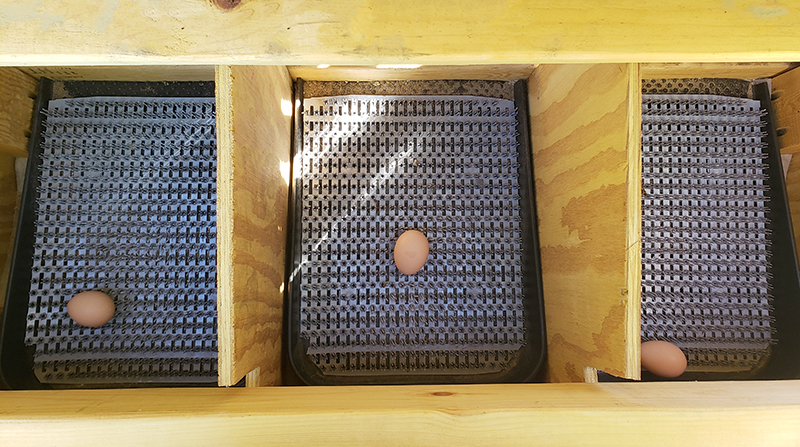
While it might seem silly, I added a homemade curtain to give our girls privacy and allow them to feel safe while laying their eggs. It works great and makes a fun statement in the coop as well!
Since my girls have started laying, they have never laid anywhere besides the nesting boxes unless by accident. (Sometimes new layers will unexpectedly lay an egg on the roost or other random places.)
Litter – Chicken Coop Features
Litter is next on my list of important chicken coop features. While some people like to call this bedding, chickens do not actually sleep in it so it technically isn’t “bedding.”
You need to use a material to act as a litter much like you would cat litter for a cat. (But NEVER use actual cat litter in a chicken coop. The chickens are liable to eat it and have it get stuck in their crop.)
The purpose of the litter is to collect and hold the chicken’s droppings. The litter needs to be cleaned or removed often to lower the buildup of ammonia. (Some chicken keepers use a deep litter method, but I have never personally attempted it for simplicity reasons.)
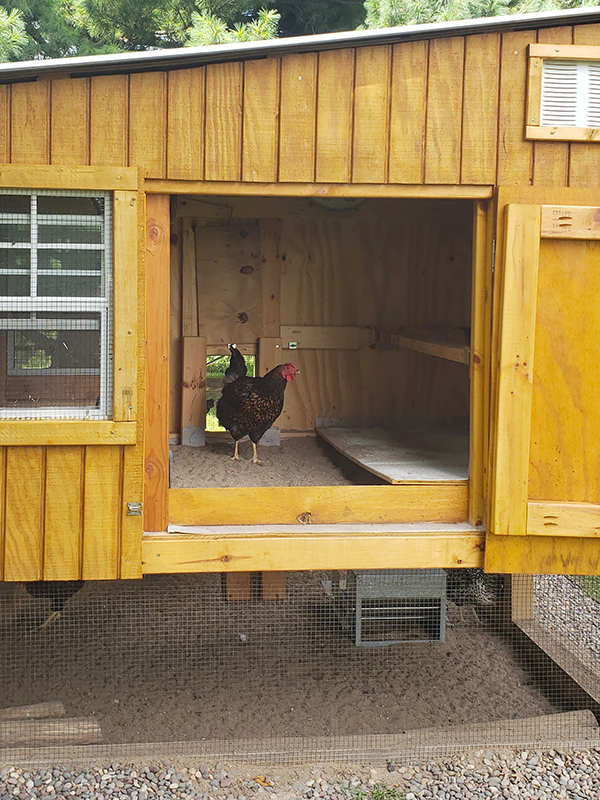
The most popular choices are either straw, sawdust, or sand. My personal favorite hands down is construction sand (do not use sandbox or pool filter sand). I simply use a kitty litter scoop to gather up the droppings each day and I’m done! I also have a droppings boards under where they sleep so I can just scrape the poop off the board and dispose of it each morning.
Ventilation
In order to keep a chicken healthy, you need to have some sort of ventilation features in the coop. The purpose of having ventilation is to avoid a buildup of possibly deadly ammonia that appears from their droppings as well as moisture buildup from their breathing.
As chickens sleep in the coop, they continue to breathe in and out as well as defecate throughout the night. When the droppings build up, so does the ammonia. As the birds breathe in and out, moisture is released into the air and also can build up.
Ammonia can be deadly to the birds if there is a high enough concentration within the coop. In addition, if the moisture is not released outside of the coop, it can also build up and cause issues like frostbite and other health issues after prolonged periods.
Ventilation is more important for large chicken farming operations as opposed to someone who is raising chickens in their backyard. As long as you are keeping your chicken coop clean and there is a small amount of airflow, most backyard chicken raisers shouldn’t have an issue.
How To Add Ventilation
Adding in a couple of small vents at the top of the coop should be plenty to allow for the air exchange to occur.
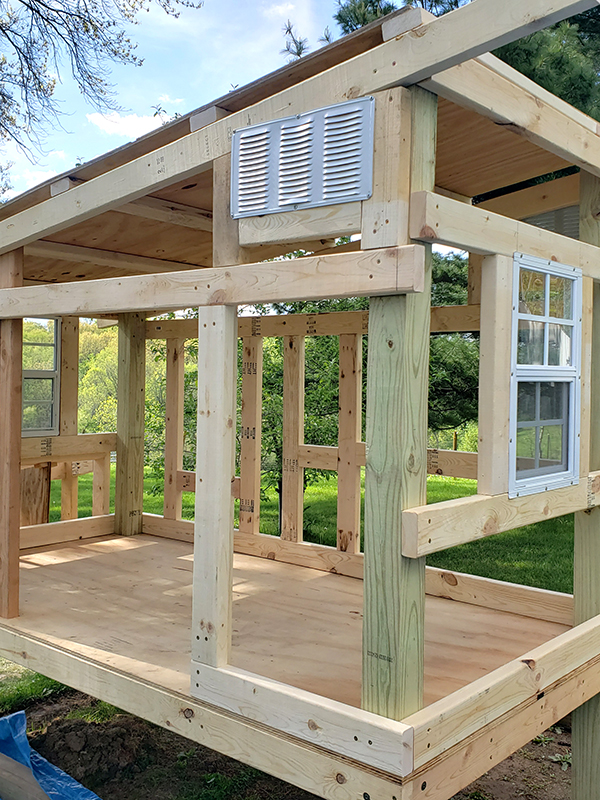
In our chicken coop, we left a small one-inch gap at the top when building to allow for fresh air to enter the coop and moisture and ammonia to leave. We also installed a couple of small vents on two sides of the coop for even more ventilation.
You do want to make sure that the ventilation is up high enough so that it is above the birds’ heads and won’t cause a draft during cold and windy nights. This leads me to the next item on my list.
Dry & Draft Free
While chickens are covered in feathers to help keep them warm, you don’t want your chicken coop to have a draft. This is mainly for locations that have cold winters. Be sure to keep any ventilation up and above the chicken’s heads.
As for being dry, you don’t want the chickens to sit in a puddle of water all night long. Excess moisture, as mentioned above, can cause a ton of different health issues for your birds. They need to be kept dry while they sleep. Ensure that your coop is sealed up as much as possible aside from the ventilation.
If you are building your chicken coop from scratch, have someone either walk around the outside of your coop at night with a flashlight while you are inside to look for any places where moisture or cold air might leak into the coop. Use caulk or additional boards to help seal up any large leaks that you might find.
Windows
Along with keeping chickens warm in winter, you also need to keep them cool in the summer. In fact, chickens will struggle much more with warmer temperatures than they do with cooler ones.

The windows will help to allow good airflow during hot days. We aren’t worried about drafts during the warm days, only the cold days so windows can be placed at any height.
If at all possible, try to have windows on all four sides of your chicken coop. This is simple to do if you are building your coop from scratch. You can use small pre-fabricated windows that can open and close or you can simply cut out a rectangle out of the side of your coop, attach a couple of hinges and a lock and use that as a window.
For the safety of your chickens, you need to add hardware cloth on any window opening. A simple mesh screen will not be enough to keep hungry animals from breaking in. Use the hardware cloth even on fabricated windows.
Any opening or space that a rat can fit though, I put hardware cloth on for safety. For example, the one-inch gap at the top of our coop has hardware cloth running inside so nothing can get inside.
The Chicken Run – Chicken Coop Features
Along with your chicken coop, you are going to need a space for the chickens to roam about freely. This is referred to as a “run.” The run should be enclosed in chicken wire and have roof protection overhead. The chicken run should allow at least 8 square feet of space per bird. However, the more space you can give your birds, the better. I learned this the hard way!
We have a run that is about 11 feet by 8 feet, so 88 square feet. Fully enclosed and covered with a roof. When we got chickens, we purchased only six birds but ended up with eight. So with eight birds, I needed a minimum of 80 square feet according to the guidelines. I should have been fine with my 88 square feet minimum space. However, my birds got into the habit one winter of pecking each other’s backs and now they pull feathers from one another.

I have since created a 100-square feet fenced area where my chickens can roam. It is uncovered, but the girls are free to go into this space as often as they want (we can’t free-range because we are technically within city limits). However, they still have the feather-pulling habit and that likely won’t ever stop. So the more space you can give your birds (especially if you can’t free-range), the better!
Last Thoughts
While this isn’t really one of my chicken coop features, it is still good advice. In order to keep the chickens out of the coop unless they are sleeping or laying eggs, all food and water should be kept outside of the coop and inside the enclosed run.
This will prevent chickens from hanging out and pooping in the coop. In addition, it keeps the moisture levels lower without water being inside the enclosed space. Lastly, it will also help to deter pests and other animals from trying to get in even more because there won’t be food spilled everywhere.
With just these basic items and features, your chicken coop will be the home to some happy and healthy birds! I will be doing another blog post on my favorite must-have chicken coop items and features to have that really aren’t required, but will make your life a lot easier! Be on the lookout for that post soon.
Until next time, thanks for stopping by!
– Chelsea
*This post may contain affiliate links. These are products I have used personally and highly recommend. As an Amazon Associate, I may earn a small commission from qualifying purchases if you purchase items through my links. These links and the ads on this page help to support my family and our semi homestead, so Thank You!
Discover more from Semi Homestead Life
Subscribe to get the latest posts sent to your email.