
In this article, I’m going to cover everything about Japanese beetles – How they came to the United States, what their lifecycle is like, how to identify them and their damage, and simple ways to deter or eliminate them.
Japanese beetles are considered to be an invasive species in the United States. They are a true nuisance to home growers and large-scale farmers alike.
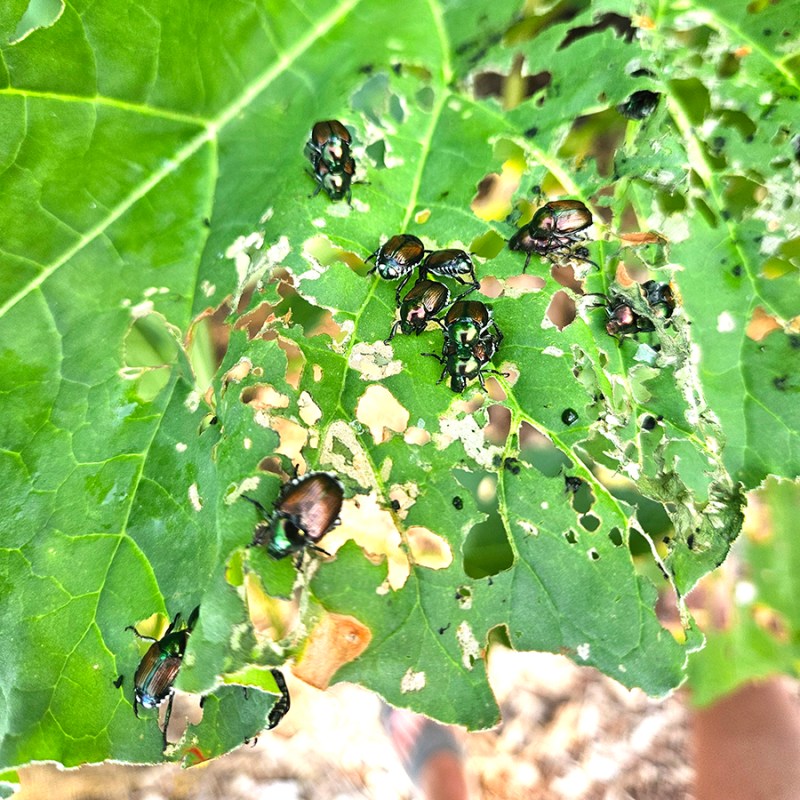
The adults feed on the foliage, fruit, and blooms of over 300 plants, including flowers, vegetables, trees, shrubs, field crops, and more. But the grubs are just as much of an issue as the adult beetles.
The grubs feed on the roots of grasses, damaging plants from below the surface long before they emerge as adults. A rise in your mole, raccoon, and bird population is often a secondary issue if you have Japanese beetle larvae around because they delight in feasting on the fat grubs.
While Japanese beetle adults might have lived hunky-dory in their native location of Japan, they are free to roam basically unchecked here in the US due to having no natural predators. This allows the adult beetles to reproduce and multiply freely, often resulting in several generations during a single summer.
How Japanese Beetles Affect Gardening & What To Do To Help
All About Japanese Beetles
Japanese beetles are considered to be an invasive species in the United States (US). They were first introduced to the US accidentally in the early 1900s after catching a ride on the roots of a Japanese iris and making their way to New Jersey.
Before then, Japanese beetles were only found in Japan, where their population was kept in check. This was thanks in part to the natural predators Japan has and the island being completely surrounded by water.
The issue with the bugs being here in the US, however, is that Japanese beetles don’t have any natural predators here. This allows them to multiply and spread virtually unchecked. And boy, do they multiply!
You can now find Japanese beetles in all Midwestern, Northeastern, and Southeastern states as well as some Canadian provinces. And they only continue to spread to more locations each year.
How To Identify Japanese Beetles & Their Lifecycle
Japanese beetles have four stages to their lifecycle. The first is the egg stage. Since they are laid about 3 to 4 inches under the soil, the eggs aren’t often seen. They can be creamy, white, or translucent in color and either oblong or round in shape.
The second stage is the larval stage. Often called “grubs”, they are chubby, one-inch-long larvae that are creamy white in color with darker heads. They tend to stay in a “C” shape, and you will only see them when digging in your garden or yard.
Larvae eventually turn into the pupae stage, where they somewhat resemble the adults. However, they are creamy white in color to begin with and turn darker as they mature.

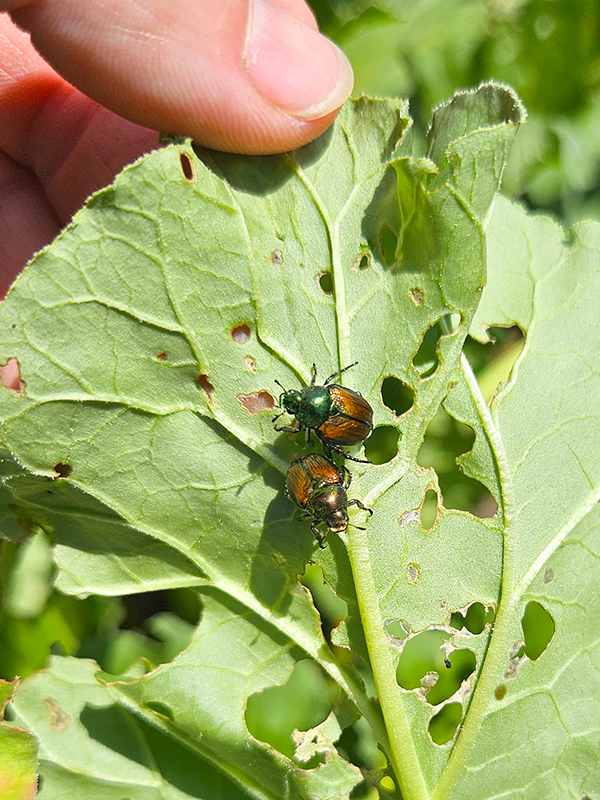
Lastly is the adult stage. Japanese beetle adults measure around half an inch long and are that classic rounded “beetle” shape. They feature metallic green heads and bodies with copper-colored wings. They also have distinctive white “tufts” of hair along the sides of their abdomens that look like little white dots. Also, where you find one adult beetle, you will often find several more not far behind.
When They Appear – Japanese Beetles & Gardening
During the winter months, Japanese beetle grubs hang out underground in the soil in grassy locations. Once spring arrives, the grubs start to head toward the soil’s surface and begin to feed on the roots of grass. Eventually, they pupate and turn into adult beetles.
Around late June here in the Midwest, the adult beetles emerge from the soil. Unfortunately, unlike some soil-borne pests like squash vine borers, Japanese beetle adults fly for several miles before finding their desired food source. This means that just because your property is grub-free, you aren’t necessarily safe from the adults.
Adult Japanese beetles only live for around 40 days, but they can accomplish a lot during that short timeframe! Infestations will often continue throughout all of July and August if left unchecked, with multiple generations of beetles appearing in one growing season.
How They Communicate & Multiply
The main issue with Japanese beetles is that they feed in masses. As a beetle feeds, it gives off pheromones that help to attract both male and female beetles to the location.

The result is loads of beetles flocking to one plant before moving on to another. That’s why you might see one plant or tree completely covered with beetles while the one right next to it stands mostly damage-free.
Each female Japanese beetle is capable of laying multiple eggs throughout July and August. Sometimes as many as 60 eggs! These eggs take about two weeks to hatch, and the process starts all over again. As the soil cools in early fall, grubs will burrow down deeper into the soil to overwinter.
Infestations are sometimes much worse during some summer months and then lighter in others due to a variety of reasons.
Identifying Japanese Beetle Damage
The first sign of a possible Japanese beetle infestation is seeing the fat white grubs when you plant your vegetables in your garden or dig in your soil. Although the adults can still fly to your property from miles away, grubs are the first sign that you might have a long summer ahead of you!
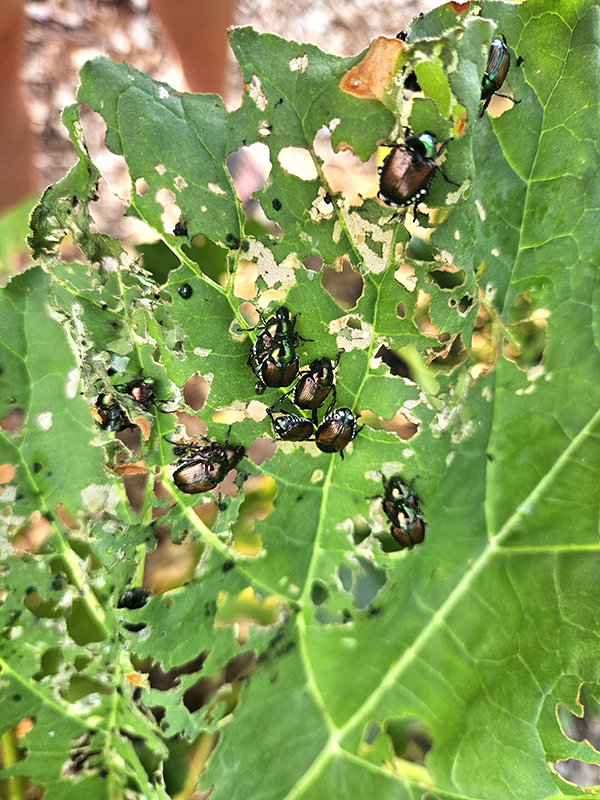
The next is actually seeing the adults flying around. If you check your garden and plants often enough, you should be able to spot early signs of an infestation. Act fast to get rid of any adults you find. Don’t wait until you have a nightmare on your hands!
As far as plant damage is concerned, the insects can eat the leaves as well as the fruit or vegetables themselves. If you see leaves that have a lacy-like appearance, you likely have a Japanese beetle problem.
You might even see leaves that have been completely stripped of all the tissue except for the major veins. After a bit, the damaged leaves will turn brown and eventually fall off altogether.
What Can You Do
I actually dedicated an entire article to how to prevent and help eliminate Japanese beetles from your property. However, here are a few ideas to get you by until you get time to read that one.
Some methods are more organic in nature and typically work well for lighter or earlier caught infestations. But, I am also including more aggressive measures that you might need to consider as well, such as pesticides. As always, you need to use what methods you are comfortable with and that work for your situation. You do you!

- Check plants often to look for damage and treat them immediately.
- Hand-pick beetles off your smaller plants and drop them into soapy water. (Or feed them to your chickens!)
- Use neem oil as both an organic preventative and a deterrent. (Product Link: Bonide Captain Jack’s Neem Oil)
- Cover delicate or young plants with row coverings or other fine mesh netting.
- Keep a healthy, well-maintained lawn and plants. (Weaker plants are usually more susceptible to pest damage and infestations.)
- Apply naturally occurring Milky Spore or Bacillus thuringiensis galleriae (Btg) bacteria to your lawn to help control the grubs.
- Avoid using commercial Japanese beetle traps. They tend to attract more adults to your property than you might normally get otherwise (thus resulting in more larvae for next year).
- When all else fails, look for commercial insecticides that are formulated specifically for eliminating Japanese beetles.
Usually, by starting early and taking measures when you first see damage, you can get a handle on Japanese beetle populations without resorting to harsher methods.
Until next time, thanks for stopping by!
– Chelsea
*This post may contain affiliate links. These are products I have used personally and highly recommend. As an Amazon Associate, I may earn a small commission from qualifying purchases if you purchase items through my links. These links and the ads on this page help to support my family and our semi homestead, so Thank You!
Discover more from Semi Homestead Life
Subscribe to get the latest posts sent to your email.