
It can be so devastating to watch your garden sweet corn crop grow from a tiny seed until it is towering almost over your head – only to have it become dinner for any number of common pests. All that work and time is gone in the blink of an eye.
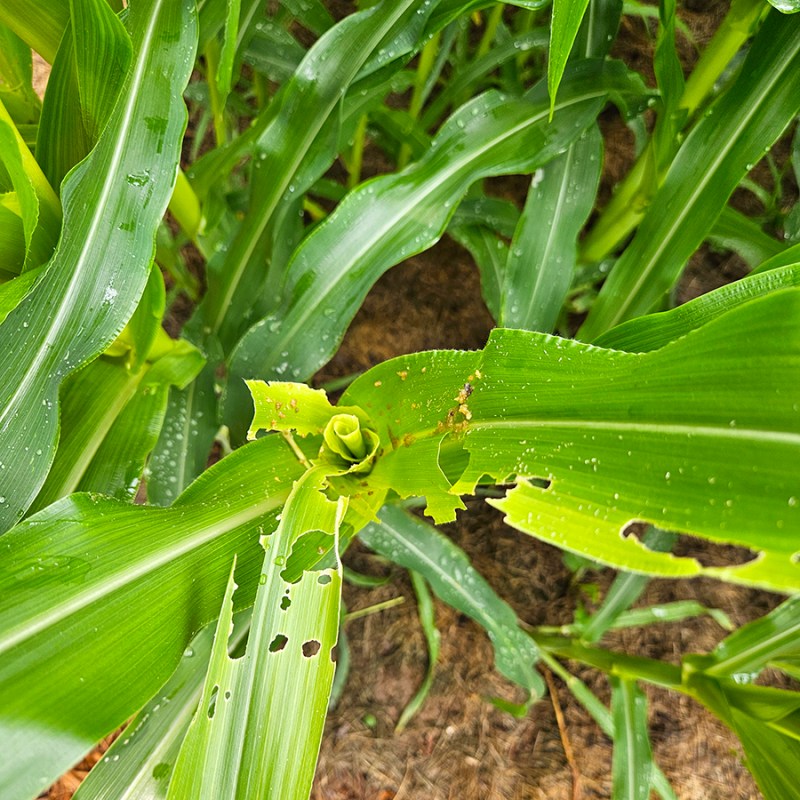
If you’ve ever grown sweet corn in your garden, then you know just how susceptible it can become to pests. And I’m not just talking about your neighborhood raccoon. (Although they are probably the most common and frustrating “big” pest you might come across!)
One day, your sweet corn is growing fine, and the next, you are finding trails of damage and destruction. Anything from the leaves to the silks to the ear itself can become a target of these tiny pests.
Most of the time, your crops can probably withstand a small infestation. (Unlike a raccoon problem, where they tend to take a few bites out of each and every ear literally RIGHT before it is ready for harvesting!)
However, it’s still a good idea to get to know these common sweet corn pests and the signs to look for. That way, if you do need to treat your plants, you know just what (or who) you are up against!
4 Common Sweet Corn Pests
You may not run into all of these pests while you grow sweet corn. There might also be others out there that are not on this list. These are just the four tiny pests that I have personally run into in my years of growing sweet corn on our semi homestead.

1: Japanese Beetles
These invasive insects are starting to become a real nuisance here in the United States. Unfortunately, there are no natural predators here, so the beetles are left to multiply and move about freely. Not only are the adult beetles a problem for gardeners and homeowners, but the grubs can also bring about a whole host of problems.
You might already be aware that Japanese beetles love to feast on many different plants on your property, like fruit trees, flowering plants, and more. In fact, they are known to cause damage to over 300 different plant species. However, they are also a huge problem for corn and soybean growers – and small gardeners alike.
While Japanese beetles can cause damage to the leaves of corn plants, that isn’t the main issue with the pests. The problem arises when they feed on the silks. This causes something called “silk clipping,” which basically means that they eat or “clip” off the silks down to the tip of the ear. This can lead to a lack of pollination. In addition, the beetles can also cause damage to exposed kernels.
For information about identifying Japanese Beetles and their lifecycle, check out my article, “All About Japanese Beetles – Everything you need to know & more!”
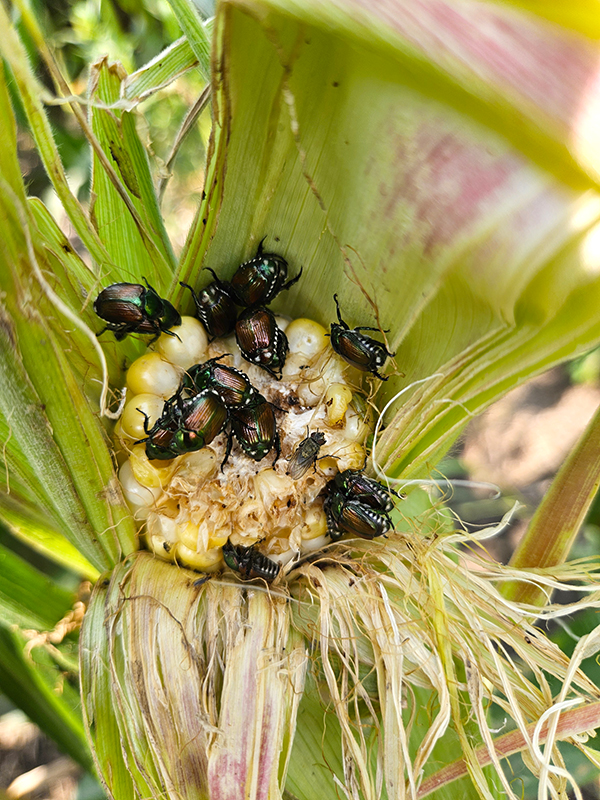
What Can You Do About Japanese Beetles?
If you have a small crop of sweet corn, your best tactic is hand removal of the Japanese beetles. It is a bit time-consuming and a sweaty job, but it is your best and safest defence. Start early and be consistent.
There are other ways of getting rid of Japanese beetles. Since they are such a common problem for gardeners, I actually have an entire article all about those strategies, including taking care of the pest at the grub stage as well. Check out my article, “Get Rid Of Japanese Beetles – 7 Ways To Stop Beetles & Grubs”, for an in-depth look at what you can do.
2: Corn Aphids – Common Sweet Corn Pests
I knew about other types of garden aphids, but I had never heard of corn aphids before just a few years ago. I was walking out inspecting my corn just as it was starting to tassel.
That’s when I saw what looked like tiny dark green spots all over some of the plants. Upon closer inspection (and a phone call to my Dad, who is a farmer and grows field corn), I came to find out they are corn aphids.
Aphids are tiny, soft-bodied insects that feed on the liquid nutrients within a plant. They have tiny mouths that pierce the plant and suck the liquid out.

In return, they produce a sap-like secretion called “honeydew” that can attract ants. This honeydew can also promote sooty mold, which can interfere with photosynthesis.
You can find aphids all over the plant, but most often they are colonized near the tassel and appear just as the tassel is starting to grow. Most often, an infestation is kept to the outer rows of your sweet corn, but the pests can move further inward during larger infestations.
What Can You Do for Corn Aphids?
The good news is that with most aphid infestations, there is rarely a big cause for concern for healthy plants. Sometimes, pollination can be disrupted, but the main issue is the lack of photosynthesis, which can lead to yield loss.
The best defense against aphids is water. Yep, plain old water. These tiny pests can easily be displaced by a strong stream of water. Once the aphids land on the soil, they are unable to get back up the plant and often die. A handheld sprayer or a hose can both do the trick.
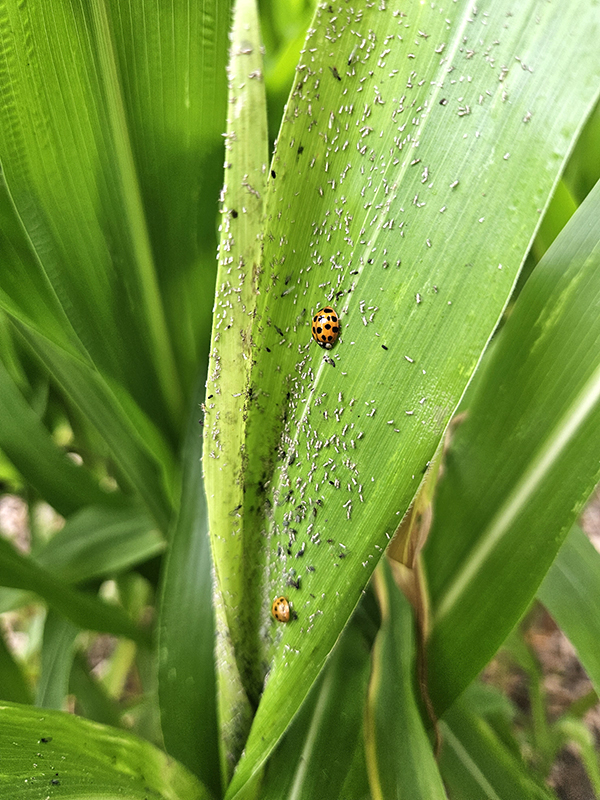
Another way to naturally control aphid populations is to encourage their natural predators to come around. Ladybugs are one of the best natural predators of aphids. We often see them hanging out wherever we have an aphid issue. Other predators include lacewings, hoverflies, pirate bugs, and some types of parasitic wasps.
3: Armyworms
This is a relatively new pest that we had to deal with in our sweet corn crop. Thankfully, we only had a couple of plants become victims before natural predators took care of the problem. However, large infestations can be a bigger cause of concern.
Armyworms are more of an issue for sweet corn that is grown in locations where there is or was a living ground cover, especially something like rye or grasses. This is because the female moths lay eggs in the ground cover. After the larvae hatch, they feast on the cover crop. Once that is gone, they move on to the sweet corn plants.

These pests often affect later-maturing sweet corn varieties (which is probably why we saw it on our second planting of corn as opposed to the first one). Armyworms feast on any part of sweet corn that is visible above the ground, including the leaves, tassels, and ears. However, they are most common on pretasseled corn.
The leaves will have holes all over them, and you will often find fecal matter left behind on the leaves as well. As the corn matures, armyworms move on to the ears themselves, burrowing into the husks and feasting on the base of the ears.
Identifying Armyworms
There are a couple of different types of armyworms. True arymworm moths are brownish tan and have small white dots near the middle of their forewings. Fall armyworm moths have more mottled forewings, again with a white spot in the middle of their forewings. Their hindwings tend to be grayish-white in color.
The females lay around 100 eggs on the leaves of sweet corn. These clusters of eggs will appear almost fuzzy in appearance, thanks to the hairs from the female’s body.

Armyworm larvae vary in color from green to black. Tan seems to be the most common. They usually feature yellow to dark stripes down the length of their bodies. The main distinction of armyworms is an upside-down “Y” shape on the front of the larvae’s head.
What Can You Do For Armyworms?
In all honesty, there isn’t a whole lot you need to do for armyworms other than hand removal. Pick the caterpillars off and drop them into a bowl of soapy water. Or, you can feed them to your chickens if you have any.
Smaller infestations can also be controlled with natural predators like wasps, parasitic flies, and birds. The good news for those who live in Northern locations like us: armyworms might not be an issue each year since they don’t overwinter here.
4: Corn Earworms – Common Sweet Corn Pests
Aside from Japanese beetles, corn earworms are probably the most devastating and frustrating common sweet corn pest. This is because they target and attack the ears of the corn, leaving them inedible. And once the caterpillars enter the husks, they are basically impossible to detect or remove.
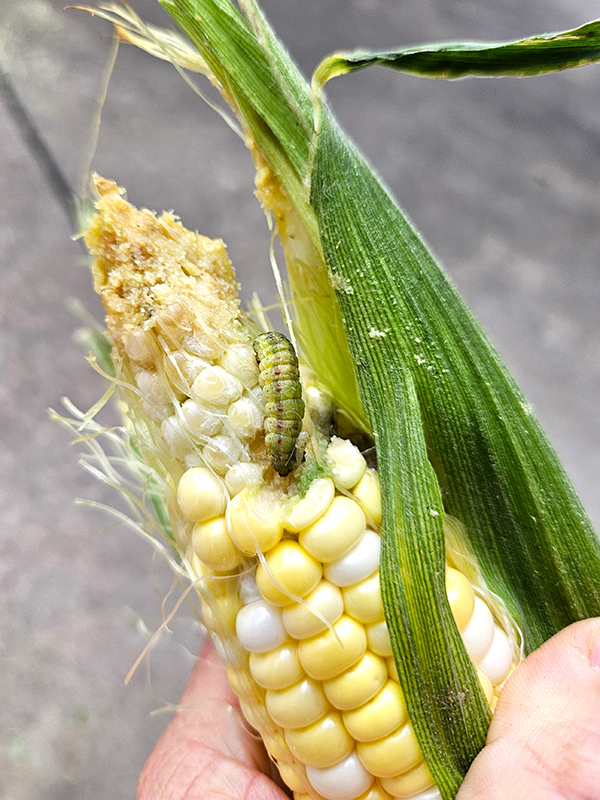
Corn earworms do not overwinter here in the colder climates. They must travel to the Midwest and Northern locations from the South. They have become a real nuisance for garden sweet corn growers and large-scale farmers alike.
Unlike armyworms, which enter the ears through the husks, corn earworms enter via the silks. This can make it difficult to even know the earworms are present until you go to shuck the corn. The pests start on the tips of the sweet corn and travel along the sides, feasting on the kernels.
If no corn is available, the corn earworms can actually attack tomato plants in your garden as well. This gives them the pseudonym, “tomato fruitworm.” Other garden plants like broccoli, beans, cabbage, lettuce, peas, peppers, pumpkins, and squash can also be targets, albeit less frequently.
Identifying Corn Earworms
Corn earworm moths are off white or tan in color. They have a dark band around each of their hind wings and one dark spot in the middle of their front wings. They lay individual eggs on the silks of the sweet corn.
The larvae can vary in color but are usually tan, brown, maroon, light green, or black (and a combination of these). Dark and/or light stripes can also run along their bodies. Their heads are usually light brown. The caterpillars grow on average 1 mm each day until they reach around 1.5 inches long.

What Can You Do For Corn Earworms?
For smaller infestations, nothing really needs to be done. If you notice a corn earworm on a few of your ears, you can always just cut off the damaged area and clean and cook as usual. Or consider those ears as a loss and move on to the next one.
For larger issues, the best tactic to use is pheromone or blacklight traps. While they won’t really help the earworm larvae that are already on plants, they will help to attract the adult moths. This is not a tactic I have personally tried, but I have read that it has good success with larger-scale issues.
Hopefully, you will now be able to identify some of these common pest issues that you might get with your garden sweet corn crop. As far as larger issues like raccoons, might I suggest an electric fence! (Product Link: Premier 1 PoultryNet® Plus Electric Fence)
Until next time, thanks for stopping by!
– Chelsea
*This post may contain affiliate links. These are products I have used personally and highly recommend. As an Amazon Associate, I may earn a small commission from qualifying purchases if you purchase items through my links. These links and the ads on this page help to support my family and our semi homestead, so Thank You!
Discover more from Semi Homestead Life
Subscribe to get the latest posts sent to your email.