
If you are looking for tips on integrating new chicks into an already established flock, this article is for you. A few simple tips can go a long way to making the process go smoothly for all involved.
By the time that new baby chicks turn about 6-7 weeks old, I’m more than a little ready to get them out of the house and outside in the chicken coop. Not only is it a hassle to give them food and water daily (due to the fact that they LOVE to fly out of the brooder each time the lid is opened) but the dust they produce is enough to drive anyone mad!
For most locations, you need to wait until baby chicks are at least 6-7 weeks old before moving them outside. This is because up until that time, they don’t have their full feathers and can’t regulate their body temperatures.
However, once their adorable soft downy feathers are all gone, it’s time to kick them out of the house. While that isn’t an issue really if this is your first set of chickens, it can be a bit trickier when you have an already established flock on your homestead.
So I’ve put together a few tips that I use to help ease the transition from indoors to outdoors so you can get your house back (after a long dusting session) and your chicks can enjoy all the fun that the outdoors has to offer with their new older friends.
My Top Tips For Integrating New Chicks Into Your Flock
Keep in mind that these tips are for baby chicks that you raised inside your home or garage. Obviously, chicks that have been raised by a hen are already integrated into the flock with the help of the hen so these tips don’t apply to them.
The Right Timing
As mentioned above, you need to wait until the chicks are at least 6 to 7 weeks old before transitioning them outside. However, if you live in a location that has warmer weather, then you can probably get by with starting the transition sooner.

For our location here in Illinois, we have to be a bit more cautious before moving new chicks outside. This is because of the weather fluctuations in the Midwest. We often have temperatures that change 30 to 40 degrees just from daytime to nighttime. Because of this, moving baby chicks outside in the spring can be tricky.
For the most part, as long as the chicks are fully feathered, I try to move them outside once the temperatures during the day and night don’t drop below 50-60º Fahrenheit. That doesn’t typically happen until mid-May here.
That timing plays a factor in when I purchase chicks. If I purchased chicks in early March, then the temperatures outside wouldn’t be warm enough after 6 weeks. I would then have to keep the teenage chicks in my house that much longer.
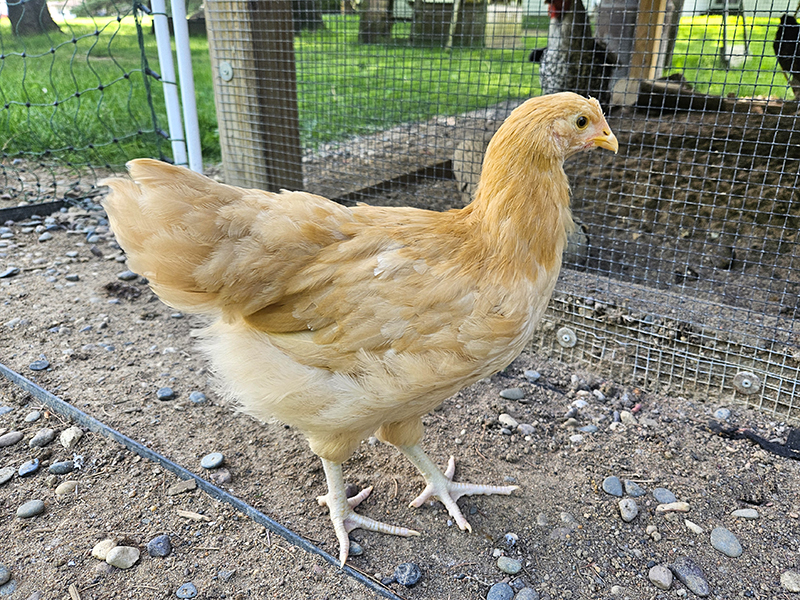
It is also better to move chicks that are bigger and closer in size to your adult chickens. This will make them less vulnerable and likely to be targeted by bully adult chickens. By about 7-8 weeks, the teenage chicks are a decent size and can handle a bit of abuse if needed.
Our Setup
At our homestead, we have a homemade 4×8′ raised coop that has an automatic door that closes and opens. Around that coop is an enclosed chicken run. The run has hardware cloth all around it as well as a roof. This gives the ladies a place to hang out if the weather is bad while still being safe from predators. (Product Link: Omlet Automatic Door)
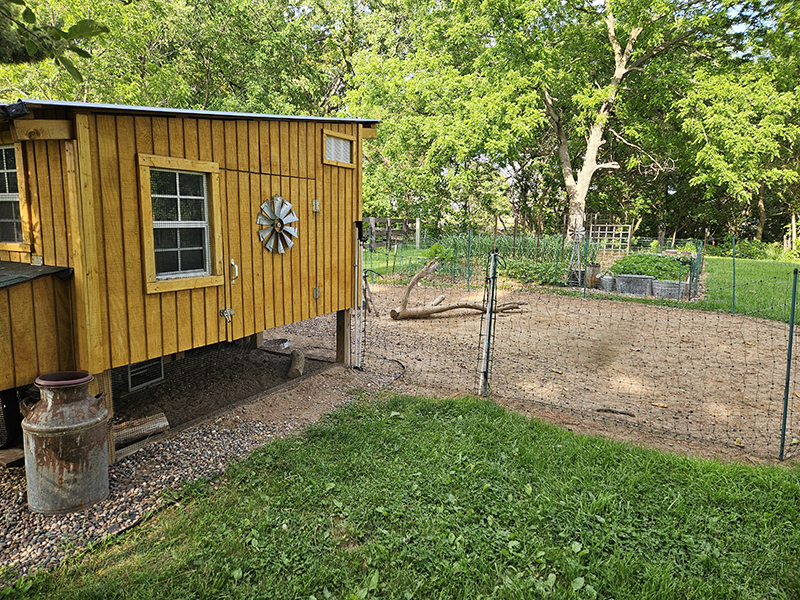
We also have a larger fenced-in area that encloses the coop and run. The girls are able to go into this area during the day once the automatic door opens.
We can’t fully free-range our chickens because we technically live in city limits even though we are on the outskirts and at the end of a dead-end road. I do let the girls free-range though if I am outside in the garden or the kids are outside. (Our mini Aussie helps to herd them back in if needed . . . even if it isn’t the more proper way!)
Dog Kennel Trick – Tips For Integrating New Chicks
The transition from inside to outside can be a bit overwhelming for young chicks. They are used to the same environment, same temperatures, no wind and sun, etc. So the goal is to keep them as calm as possible if you can.
If you were to just toss the new chicks out with the big girls, chances are that the older ladies would see the chicks as intruders. They would then become a victim of pecking and bullying. So the key is to allow the older ladies to get used to the new gals slowly.
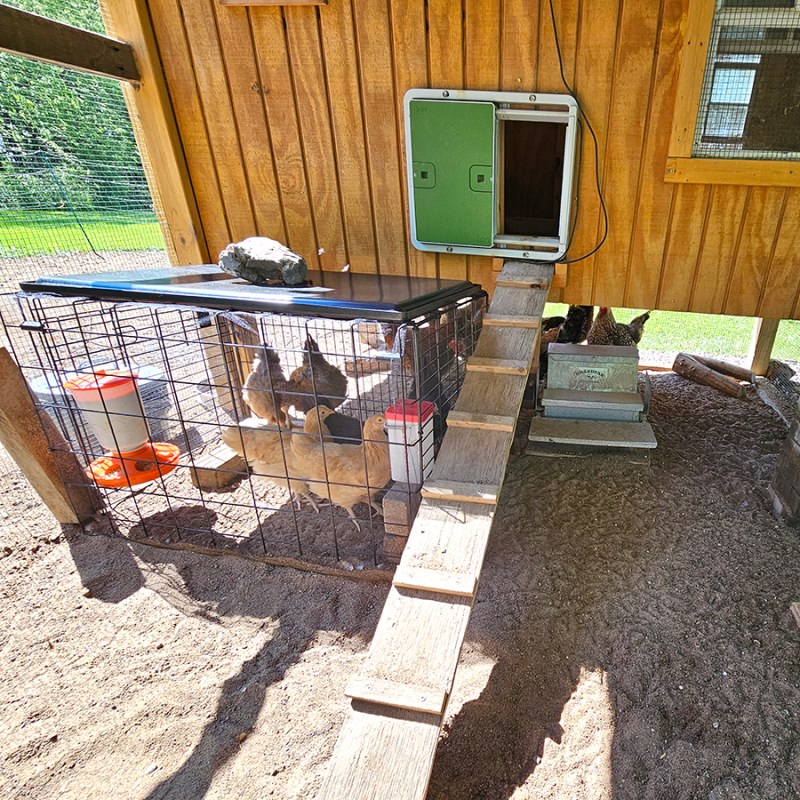
To do this, I keep the young girls in a metal dog kennel. You can use whatever you have on hand or even rig up a fenced-off area within your chicken run if you have the space. The key is to make sure it is safe yet separate from the original flock.
The older chickens should be able to see the chicks and get right up to them. This helps the hens get used to the pullets being around. Eventually, they will ignore and not care about the chicks at all.
By keeping the kennel in the run, I can close the man door on the run and keep the chicks predator-safe at night (the bars on the dog kennel are too wide to keep most predators like coons out).
Separate Food And Water
The chicks have their own set of feeders and waterers within the dog kennel. This allows them to eat and drink without worrying about the older ladies taking over.
As for food, the chicks still have their starter feed while the hens are getting layer feed. Once the two are loose together, I’ll switch to Flock Raiser and make sure to keep oyster shells on hand if the older girls need the extra calcium.
In addition, they also have a roost to help them get used to sleeping on a 2×4 board at night. We started using one when the chicks were still in their brooder.

Supervised Playtime – Tips For Integrating New Chicks
After about a week, I then start to allow the chicks to mingle with the older girls. However, I only do this if they can be supervised at first because you never know how the older ladies will act.
Allowing them both to roam the fenced-in area is best so they aren’t so “cooped up” together (pun intended!). If the older ladies don’t seem to mind the chicks, you can start to leave them out all the time.
During the night, you will likely need to assist the chicks and help them find the roosting bars. As much of a pain as it might be, go out each night and physically place each chick onto a roost bar if need be. They will eventually get the hang of it.
It’s best if you have a specific bar or space for the new chicks to roost so they don’t have to fight with the hens. However, this isn’t always practical so just do the best you can. As long as they are in place at night, that’s all that matters.
You may need to close off the nesting boxes at night. These boxes might seem like a safe place for the chicks to roost so closing the boxes helps to discourage that.

The key is to get them used to going into the coop at night with the older ladies. It won’t take long for everyone to get bored with one another and new routines will ensure.
Some Pecking Is Normal
Another one of our tips, don’t be surprised if there is some light pecking and bickering when integrating new chicks. It’s normal for chickens to do this to maintain a pecking order. If you have excess bullying though, you need to reassess the situation. You may need to remove a hen from the flock if she continues to obsessively peck at the chicks.
Before you know it, your new larger flock will be getting along just fine – and just in time to add even more chicks to the bunch. You know what they say, “chicken math” is definitely a real thing!
Until next time, thanks for stopping by!
– Chelsea
*This post may contain affiliate links. These are products I have used personally and highly recommend. As an Amazon Associate, I may earn a small commission from qualifying purchases if you purchase items through my links. These links and the ads on this page help to support my family and our semi homestead, so Thank You!
Discover more from Semi Homestead Life
Subscribe to get the latest posts sent to your email.